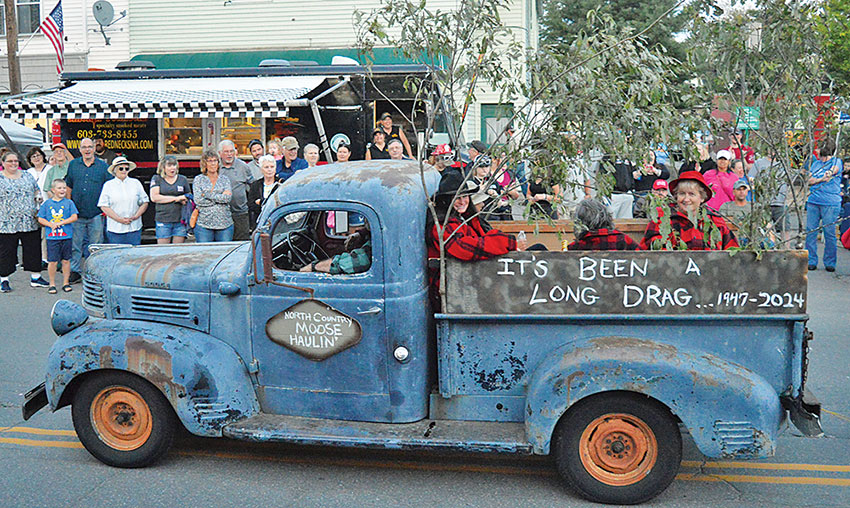
OUT HAULIN'
Ron Farnsworth brought out his 1947 Dodge truck to haul a moose (just out of frame) down the street during the Moose Festival parade down Main Street in Colebrook on Friday night. (Jake Mardin photo)
The News and Sentinel Publishes Its Final Issue, Ending a 154-Year Run
The past several years of declining advertising revenues and readership numbers have taken their toll, and today's issue is the last for The News and Sentinel. "This was by no means an easy decision," said editor and publisher Karen Harrigan, who represents the third generation of her family's stewardship of this community institution. "We have a great team of people working here, many readers and contributors who care deeply about the paper, and some longtime, faithful advertisers who have trusted us to promote their businesses, all of whom I kept in mind while weighing the options for the paper's future." Two years ago an effort to sell the business, and thereby ensure its future as a community newspaper, was unsuccessful. "We came close, but it didn't happen, and at that point I knew the writing was on the wall," Ms. Harrigan said. "We never regained our pre-Covid advertising level, and over the past few years our region has undergone a sea change that has worked against us." Increased opportunities for people to work from home and the growth of highspeed Internet access in the region have brought more young professionals and families here to live. "The makeup of our North Country has changed, along with the habits of younger generations who don't look to a hometown newspaper for their news, or to advertise their businesses," she said. "Keeping a newspaper afloat has become an uphill battle against an increasing dependence on social media, and that's a trend that we simply can't overcome." The paper traces its roots to 1870, and is the longest continuously operating business in Colebrook. Karen's grandparents Fred and Esther Harrigan ran it from the late 1950s until their deaths in 1990 and '91, at which point their son John took over. Karen joined The News and Sentinel in 1997, became editor in 2000, and bought the paper from her father in 2002. The paper was printed here in the building on Bridge Street until the mid-1970s, then under contract with the Newport Daily Express in Vermont, later at Co�s Junction Press in Lancaster, Upper Valley Press in North Haverhill, and for the past ten years at the Concord Monitor Press. The business employs four full-time and four part-time people, complemented by several contracted writers and photographers.
(Issue of August 28, 2024)

GETTING A BIG LIFT
Loretta Kyle of Franconia got a lift from Steve Clogston and the Eversource bucket truck to enjoy a 60-foot, bird's-eye view of this year's Moose Festival on Saturday, August 24 in Canaan. The bucket truck view proved to be a very popular attraction this year.(Alan Farnsworth photo)
Citizens Committee to Meet Sept. 12 on Proposed ATV Season Extension
By Jake Mardin
At the request of the N.H. Department of Natural and Cultural Resources and N.H. Fish and Game, the Connecticut Lakes Headwaters Citizens Committee will hold a special meeting to provide input on a proposal to extend the ATV riding season on CLH trails in Pittsburg from September 30 to Columbus Day. The meeting is scheduled for 6 p.m. on Thursday, September 12 at the Pittsburg fire station. The Great North Woods Riders ATV Club submitted a request to the N.H. Bureau of Trails to extend the OHRV riding season through Columbus Day weekend on the 11 miles of trails situated on CLH property in Pittsburg. The DNCR reviewed the request, and denied it based on feedback from Fish and Game and several members of the Citizens Committee, relating their concerns that extending the season would create conflicts with other users, including hunters, and put a greater strain on conservation officers. With the extension denied, those trails are currently slated to close on September 30. The ATV club sent a letter to DNCR Commissioner Sarah Stewart and Trails Bureau Chief Craig Rennie, asking them to reconsider the decision, arguing that opening the trails would be an economic benefit to local businesses and keep the riding season consistent between different trail systems. The GNWR, with the approval of the selectboard, police department and CGH Land Trust, is keeping its trails open through Monday of Columbus Day weekend; however, the club noted that without the CLH trails, Pittsburg will essentially be an island without connectivity to other systems. Earlier this month, business owners met with state officials to voice their concerns during a meeting at the fire station. At that meeting, officials agreed to schedule another meeting to hear concerns from all parties.
(Issue of August 28, 2024)
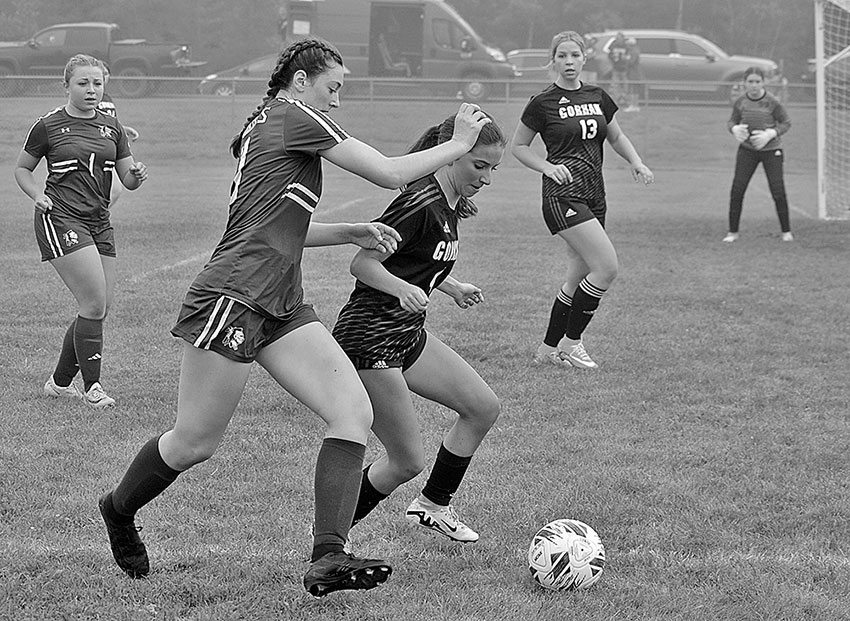
BATTLE FOR THE BALL
Colebrook's Haley Rossitto fights for possession against Gorham during Saturday's preseason soccer jamboree in Groveton. Following the action is teammate Arlyn Dorman.(Jake Mardin photo)
Errol to Celebrate 250th Anniversary This Weekend
Errol's 250th Anniversary Planning Committee invites everyone to attend the celebratory event being held this weekend, on Saturday and Sunday, August 31 and September 1. The majority of events will take place on Saturday throughout downtown Errol, starting with a morning paddle down the Androscoggin at 9 a.m., hosted by Northern Waters Outfitters and Northern Forest Canoe Trail. Crafters, food vendors and community organizations will be set up for a vendor fair at the Errol Consolidated School from 10 a.m. to 3 p.m., and the Classic Car Show will be displayed just across the street behind the Errol General Store from 10 a.m. 1 p.m. Spectators can cast their vote for Best of Show awards for one car and one truck. All ages will enjoy "The Magic of Jason Purdy," skilled magician and illusionist, at the First Church of Errol Congregation from 11 a.m. to noon. Visitors can take a step back in time with two historical offerings. A slideshow of photos from Errol's 200th Anniversary in 1974 will take place from 10 to 11 a.m. at the Errol Fire Station, and the Errol Heritage Commission will host a display of artifacts just next door at the Jail House from 10:30 a.m. to 12:30 p.m. A parade celebrating Errol's 250 years of history will step off on Main Street at 1 p.m. Anyone is welcome to join, and participants should line up at 12:30 p.m. at the state shed. A presentation by Squam Lakes Natural Science Center will take place at 2:30 p.m. at the First Church of Errol Congregation. "Animals with a Bad Reputation" will introduce the audience to live animals that have a bad "rep" and help them consider the good side of these wild neighbors. The Errol 250th Planning Committee encourages the community to come together for dinner on Saturday evening at the Errol Town Hall. The meal will be a catered barbeque by the White Mountain Chalet Caterers at $10 per plate, and seatings will be offered at 4 and 5 p.m. to ensure that everyone can be accommodated. Due to the limited space, the committee is requesting reservations for one of the seating times, either ahead of the date on Facebook or at www.errolnh.org, or by visiting the 250th Committee's information booth during the vendor fair. Following dinner, everyone is invited to head back to the school for music and dancing with The Patrick Ross Band, starting at 6 p.m. Dancing shoes, chairs, blankets and bug spray are encouraged to ensure a comfortable evening. The day of festivities will conclude with a celebratory fireworks show beginning around 9 p.m. There are two events on Sunday, September 1, starting with the Errol Heritage Commission's rededication of the veterans' monument in front of the school at 10 a.m. The celebration events will conclude with an Abenaki and Wabanaki Storytelling Program at 11 a.m. The storytelling presentation will take place online (via zoom) and can be enjoyed from the comfort of home or with neighbors at the fire station. This event will be held rain or shine, and those seeking more information may visit the Errol NH 250th Celebration page on Facebook, or email [email protected].
(Issue of August 28, 2024)
| 
